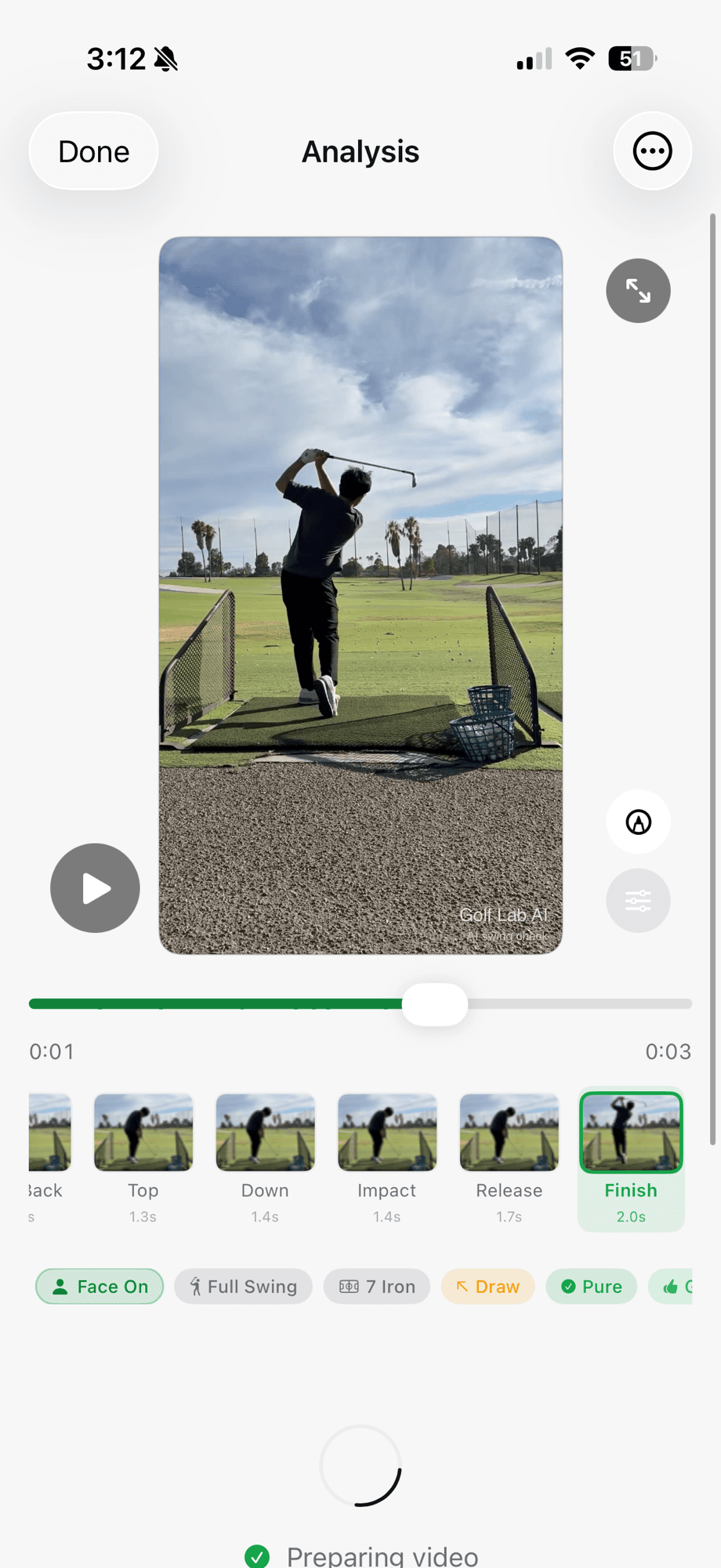
A position helps you find the moment. The swing is still a motion, and the cause of a pattern often appears before the frame where the problem becomes obvious.
Why Golf Lab AI uses eight positions
Golf instruction uses several naming systems, including ten-position “P” systems and event-based swing models. Golf Lab AI presents eight plain-language checkpoints so a golfer can move through a short video without translating labels first.
The eight labels are a navigation and analysis framework, not a claim that every effective swing must match the same model.
Setup
The address position before the club moves.
Posture, balance, ball position and alignment provide context for everything that follows.
Takeaway
The early movement as the club leaves the ball.
The relationship between the hands, clubhead, chest and lower body begins to shape the backswing.
Mid-Back
The club and lead arm continue toward the top.
Turn, width, wrist set and body sway become easier to see from the appropriate camera view.
Top
The change of direction between backswing and downswing.
The top is a checkpoint, not a pose to copy. Transition sequence matters more than matching one shape.
Downswing
The club and body organize toward the strike.
Shaft direction, hip depth, hand path and body rotation can reveal the options available at impact.
Impact
The brief interval when the club meets the ball.
Ordinary phone video cannot directly measure every impact condition; ball flight and strike data remain important.
Release
The arms and club move beyond impact.
Extension, rotation and balance can show how the player managed the face and path through the strike.
Finish
The completed motion after the shot.
A stable finish can reflect balance and intent, but it cannot prove the quality of the strike by itself.
What positions cannot tell you alone
- The exact clubface angle, club path, speed or strike location without appropriate measurement hardware.
- Whether a distinctive position is harmful for that golfer’s anatomy, intent and ball flight.
- Which earlier movement caused the position.
- Whether one drill will transfer from rehearsal to a normal shot.
How to compare two sessions
- Use the same camera view, height and distance.
- Use the same club and record a normal shot.
- Compare the relevant position, then watch the motion into and out of it.
- Record what the ball did and where the club struck it.
- Decide whether the practice priority improved—not whether every frame became prettier.
Keep learning
Set the camera correctly
Make the eight checkpoints more comparable with a repeatable view.
Explore common swing patterns
See which positions can reveal over-the-top, extension, sway and other patterns.
Read the methodology
Understand how swing detection, position mapping and the verdict fit together.
Try the analyzer
Three complete swing check-ins are free each month.