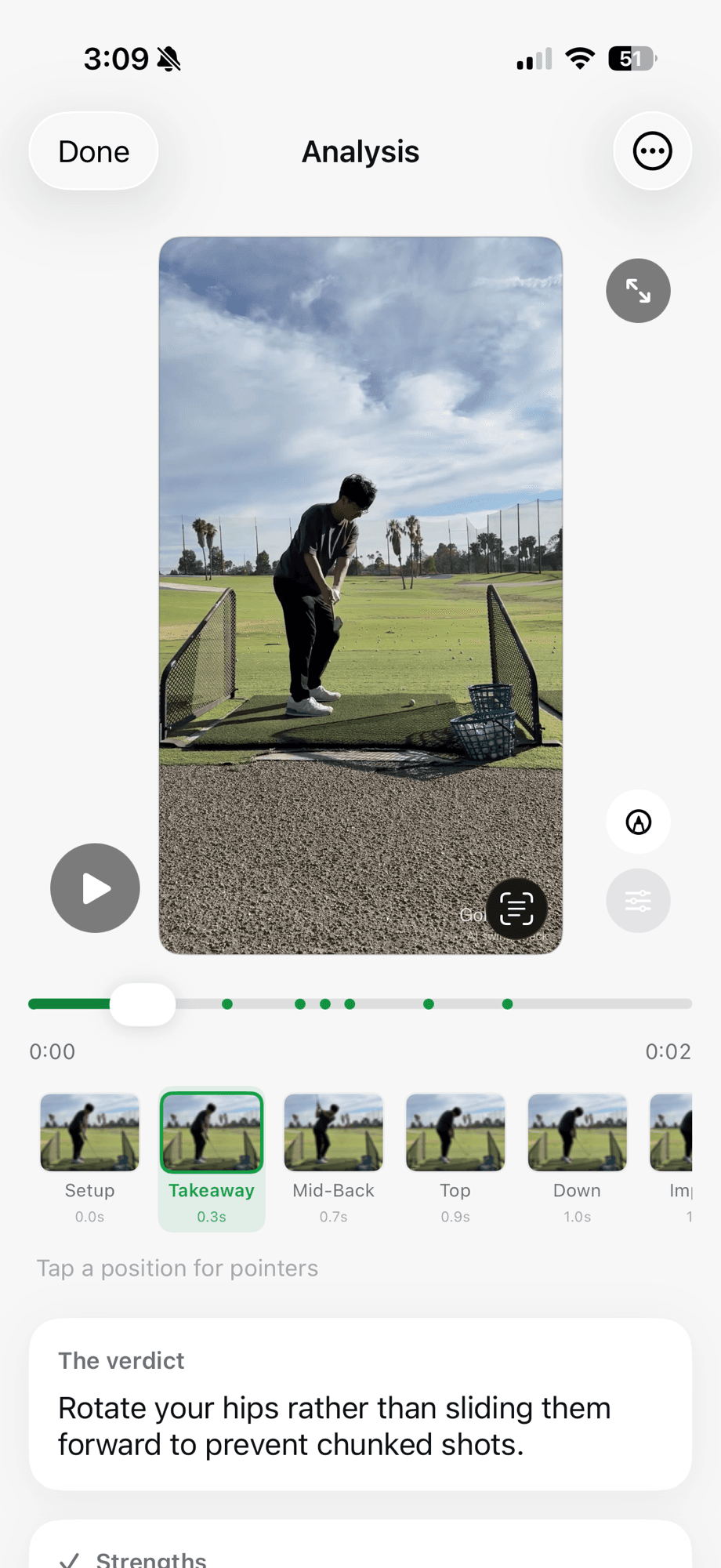
A swing-fault label describes what the motion looks like. It does not automatically explain why it happened or which change should come first.
Start with the view, not the label
Camera placement changes the apparent plane, body angles and position of the club. Before deciding that a swing is steep, across the line or moving too much, record a repeatable down-the-line or face-on view and check several swings.
Ball flight and strike still matter. Two golfers can create a similar-looking frame for different reasons, and the same visual pattern can produce different shots depending on face angle and contact.
Top and Downswing
Over-the-top golf swing
“Over the top” usually describes a downswing in which the club and arms move outward early in transition, often sending the club across the ball from outside to in. It is a pattern, not a complete diagnosis: face angle, strike and ball flight still determine the shot.
See the video checkpoints →
Downswing and Impact
Early extension in the golf swing
Early extension is the common label for the pelvis moving toward the ball during the downswing while the body stands up out of its address inclination. Some extension is essential through impact; the issue is losing space too soon.
See the video checkpoints →
Top and Downswing
Casting the golf club
Casting describes releasing wrist angles and clubhead speed very early in the downswing. The clubhead can move away from the body before the hands have lowered, reducing the player’s options later in the swing.
See the video checkpoints →
Impact and Release
Chicken wing after impact
A “chicken wing” is the common name for the lead elbow bending and moving away from the body through or just after impact. It is often a compensation rather than the original cause of the shot.
See the video checkpoints →
Setup, Mid-Back and Top
Hip sway in the golf swing
Golf requires pressure to move. “Sway” usually refers to the pelvis translating away from the target in the backswing without enough turn, making it harder to recenter consistently.
See the video checkpoints →
Top, Impact and Finish
Reverse pivot pattern
“Reverse pivot” is used for several different patterns. Most often it describes the upper body tilting toward the target in the backswing, followed by the player moving away from the target through impact. Motion and pressure—not one frozen frame—provide the useful context.
See the video checkpoints →
How to use this library
- Choose the page that matches the pattern you are trying to understand.
- Confirm that your camera view is appropriate and repeatable.
- Compare several swings instead of diagnosing from one still frame.
- Test one low-speed rehearsal and observe the strike and ball flight.
- Ask a teaching professional when the pattern persists, causes pain or remains unclear.
Keep learning
How to film a golf swing
Set up useful down-the-line and face-on video before evaluating a position.
The eight swing positions
Understand what setup through finish can—and cannot—tell you.
How Golf Lab AI analyzes a swing
See the complete path from local swing detection to the final verdict.
AI golf swing analyzer
Explore the product, free tier, pricing and practical limitations.