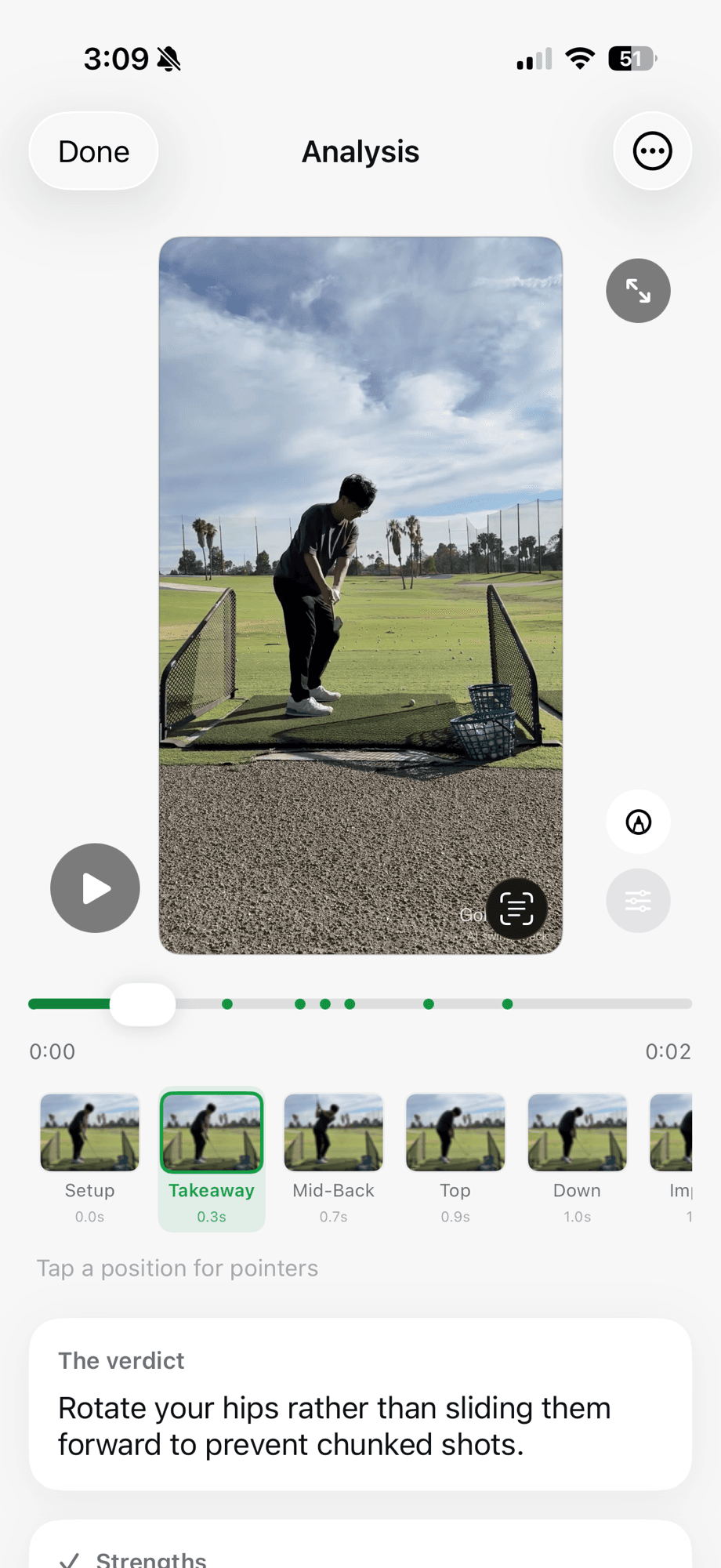
Golf requires pressure to move. “Sway” usually refers to the pelvis translating away from the target in the backswing without enough turn, making it harder to recenter consistently.
Best camera view
Face on, with the camera centered on the player and the feet visible.
Useful checkpoints
Setup, Mid-Back and Top
What to look for on video
- The trail hip moves well outside its address position instead of turning around the player.
- The upper body and pelvis drift together away from the target.
- Recentering begins late, leaving a rushed downswing or a hang-back through impact.
What the ball flight might show
- Low-point and contact can become inconsistent, but pressure shift and strike data are needed for context.
- Some lateral pelvis movement is normal and should not be removed simply to make a still frame look centered.
Video is most useful when it is paired with the club used, strike location and what the ball actually did. A visual pattern is evidence, not the whole answer.
Possible causes
These are hypotheses to investigate—not a list of changes to make simultaneously.
- Mistaking weight shift for moving the whole body laterally.
- Limited awareness of how the trail hip should gain depth during the turn.
- A stance or setup that makes balanced rotation difficult.
One drill to test
Trail-hip wall turn
Stand in golf posture with the outside of the trail hip a hand-width from a wall. Rehearse without a club.
- Turn the trail pocket behind you rather than sliding it into the wall.
- Keep pressure in the inside of the trail foot.
- Recenter smoothly before turning through.
Success check: The hip should gain depth without the outside of the trail leg crashing into the wall.
Do not overcorrect it
Do not try to keep pressure perfectly centered. Athletic swings include lateral forces; the goal is a controlled turn and timely recentering.
Stop any drill that creates pain. If the pattern is persistent or the cause is unclear, share several swings and the resulting shots with a qualified teaching professional.
Keep learning
Over-the-top golf swing
Learn what an over-the-top golf swing can look like on video, why camera angle matters, and a simple transition drill to test at the range.
Early extension in the golf swing
See how early extension can appear from a down-the-line golf swing video and try a simple chair-contact drill to test your hip depth.
Check your camera angle
Use repeatable down-the-line and face-on setup before comparing positions.
Read all eight positions
Understand setup through finish without judging the swing from one frozen frame.