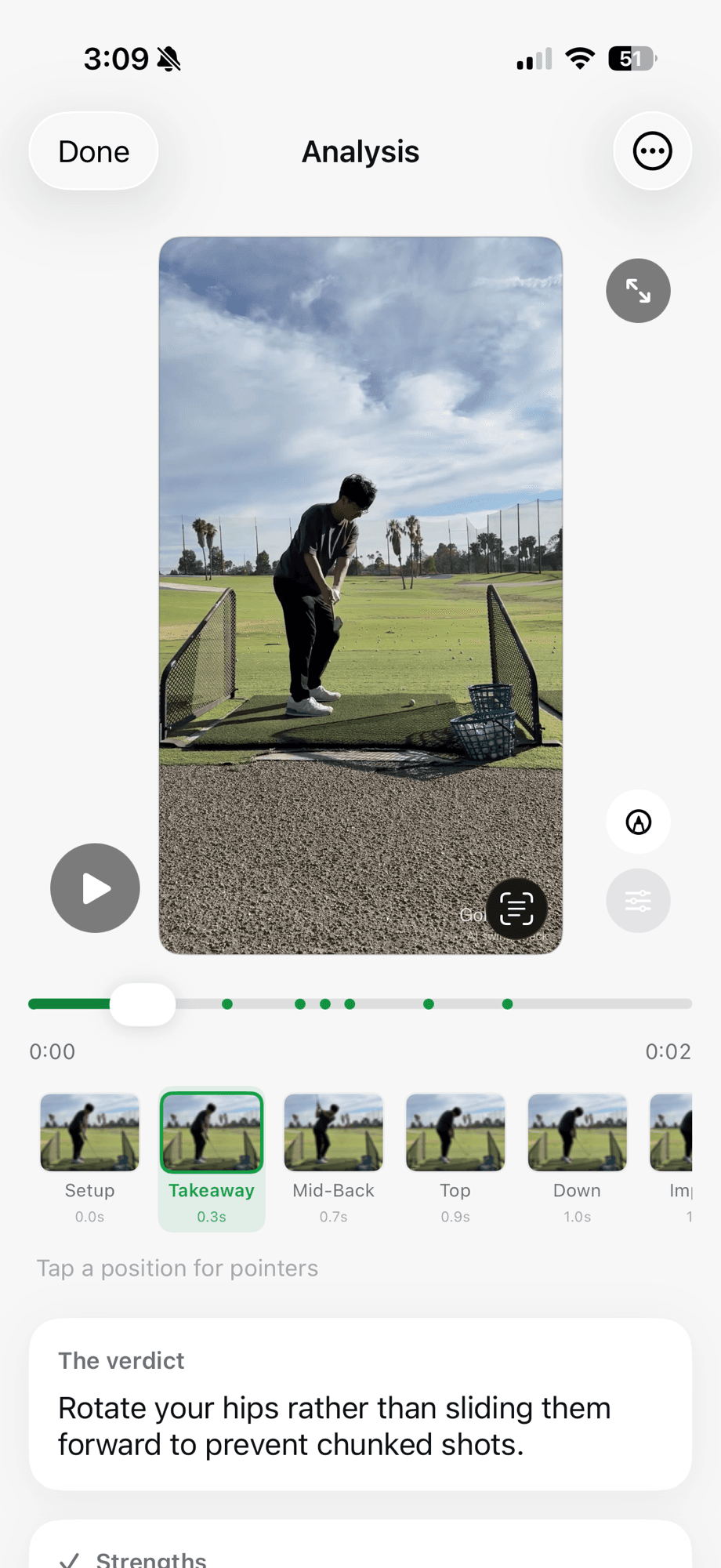
Early extension is the common label for the pelvis moving toward the ball during the downswing while the body stands up out of its address inclination. Some extension is essential through impact; the issue is losing space too soon.
Best camera view
Down the line, with the full body and club visible from setup through finish.
Useful checkpoints
Downswing and Impact
What to look for on video
- The hips move closer to the ball than they were at address.
- The player becomes taller before impact and the rear loses depth.
- The arms appear crowded, often requiring a late handle raise or hand adjustment.
What the ball flight might show
- Contact may vary between heel strikes, thin shots and blocks, but those misses have many possible causes.
- Video should be paired with strike location and ball-flight context before deciding what matters most.
Video is most useful when it is paired with the club used, strike location and what the ball actually did. A visual pattern is evidence, not the whole answer.
Possible causes
These are hypotheses to investigate—not a list of changes to make simultaneously.
- Losing balance toward the toes in transition.
- Turning without preserving enough room for the arms.
- Reacting to a clubface or path problem by standing up to create impact space.
One drill to test
Chair-depth rehearsal
At home, place a stable chair lightly behind the hips. Rehearse without a ball or club first.
- Begin with the rear lightly touching the chair at address.
- Let the trail hip retain contact during the backswing.
- In transition, feel the lead hip replace that contact as you turn.
Success check: The hips should not jump toward the ball in the rehearsal. When adding a club, use slow half-swings before progressing.
Do not overcorrect it
Do not force the hips backward or lock the knees. The goal is usable space and balance, not maintaining one rigid body angle.
Stop any drill that creates pain. If the pattern is persistent or the cause is unclear, share several swings and the resulting shots with a qualified teaching professional.
Keep learning
Over-the-top golf swing
Learn what an over-the-top golf swing can look like on video, why camera angle matters, and a simple transition drill to test at the range.
Casting the golf club
Understand what golfers mean by casting, where it appears in a swing video, and how to rehearse better sequencing without forcing lag.
Check your camera angle
Use repeatable down-the-line and face-on setup before comparing positions.
Read all eight positions
Understand setup through finish without judging the swing from one frozen frame.