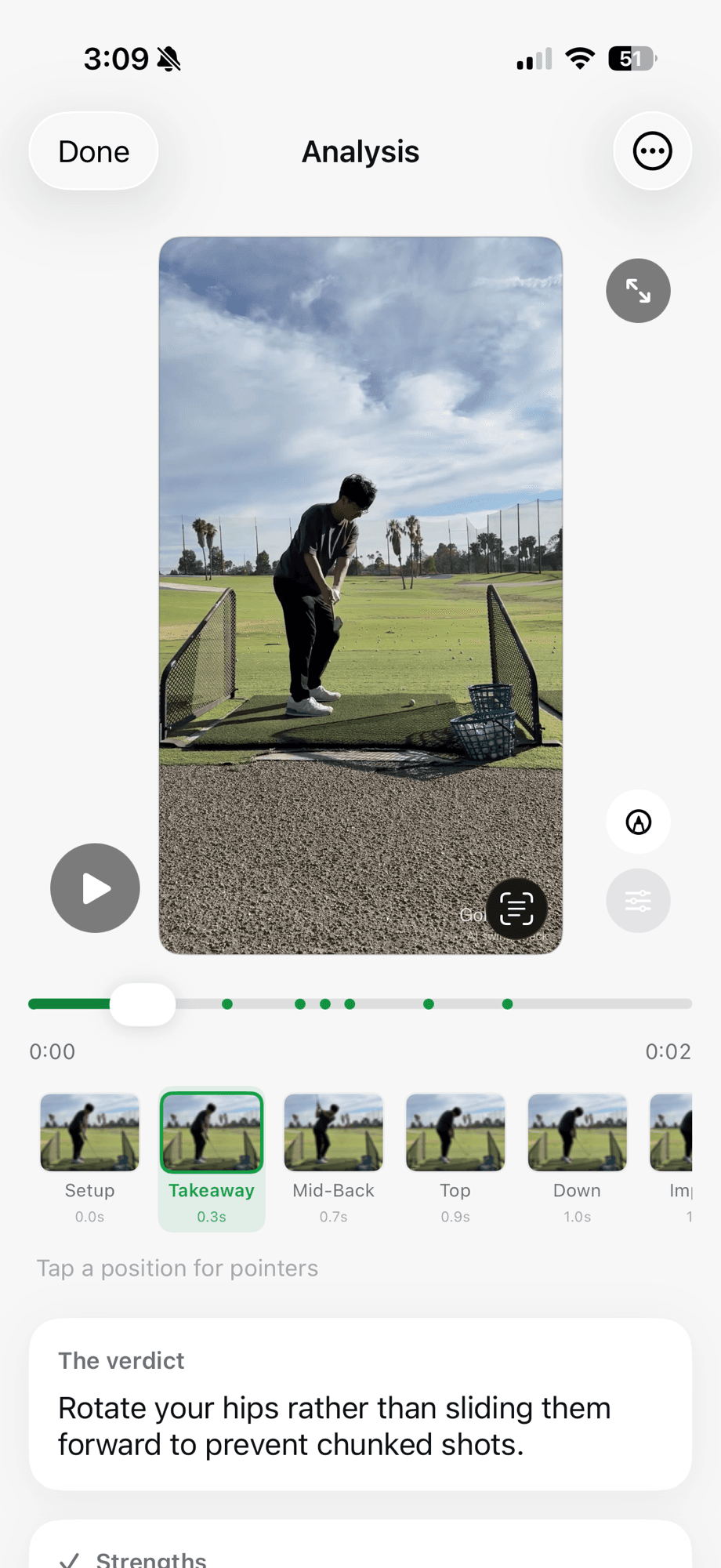
“Over the top” usually describes a downswing in which the club and arms move outward early in transition, often sending the club across the ball from outside to in. It is a pattern, not a complete diagnosis: face angle, strike and ball flight still determine the shot.
Best camera view
Down the line, with the lens aligned approximately through the hands at address.
Useful checkpoints
Top and Downswing
What to look for on video
- The hands and club move toward the ball or target line immediately from the top instead of gaining depth.
- The downswing shaft appears noticeably steeper than the backswing shaft from a correctly aligned camera.
- The trail shoulder moves out toward the ball early, leaving less room for the arms through impact.
What the ball flight might show
- Pulls and pull-slices are common when an outside-in path is paired with different face angles.
- A fade alone does not prove an over-the-top motion, and some playable swings intentionally move left through impact.
Video is most useful when it is paired with the club used, strike location and what the ball actually did. A visual pattern is evidence, not the whole answer.
Possible causes
These are hypotheses to investigate—not a list of changes to make simultaneously.
- Starting the transition mainly with the shoulders and arms.
- Trying to square an open clubface by pulling the handle left.
- A backswing position that leaves the player searching for space on the way down.
One drill to test
Pause-and-drop transition rehearsal
Make slow waist-to-waist rehearsals without a ball before trying short shots.
- Pause briefly at the top of a three-quarter backswing.
- Let the hands lower a few inches while the chest stays patient.
- Turn through without throwing the trail shoulder toward the ball.
Success check: From down the line, the first move should create a little more room between the hands and the ball—not send the hands directly at it.
Do not overcorrect it
Do not chase a dramatically “shallow” look. Camera position can make the same swing appear steep or flat, and an exaggerated drop can create a different path problem.
Stop any drill that creates pain. If the pattern is persistent or the cause is unclear, share several swings and the resulting shots with a qualified teaching professional.
Keep learning
Early extension in the golf swing
See how early extension can appear from a down-the-line golf swing video and try a simple chair-contact drill to test your hip depth.
Casting the golf club
Understand what golfers mean by casting, where it appears in a swing video, and how to rehearse better sequencing without forcing lag.
Check your camera angle
Use repeatable down-the-line and face-on setup before comparing positions.
Read all eight positions
Understand setup through finish without judging the swing from one frozen frame.